BPI warns de minimis exemption may exclude Bitcoin transactions
Representatives of the Bitcoin Policy Institute (BPI) warned that ongoing U.S. legislative discussions on cryptocurrency de minimis tax relief may exclude Bitcoin transactions and apply only to dollar-pegged stablecoins. Conner Brown, BPI’s head of strategy, said on X that leaving Bitcoin (BTC) out of an exemption for small transactions would be a “severe mistake.”
In July, Wyoming Senator Cynthia Lummis introduced a bill proposing a de minimis tax exemption for cryptocurrency transactions of $300 or less, with a $5,000 annual cap on tax-free transactions and sales. The proposal also includes tax exemptions for digital assets donated to charity and tax deferral for crypto earned through proof-of-work (PoW) mining or staking to secure blockchain networks.
Bitcoin advocates contend that exempting small-value BTC transactions would encourage its use as a medium of exchange rather than solely as a store of value, potentially supporting broader payments adoption.
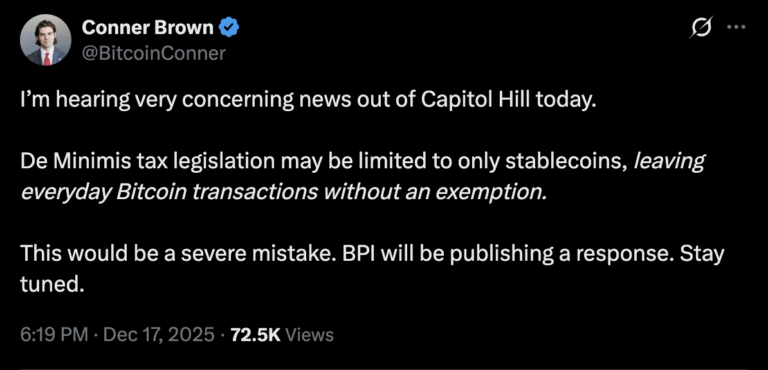
The discussion has also focused on whether such relief should extend to stablecoins, which are designed to maintain a steady price. Marty Bent, founder of TFTC, questioned the need for an exemption for stablecoins on X, noting their intended price stability and calling the idea “nonsensical.”
Requests for comment sent to BPI regarding the status of the proposal had not been returned by the time of publication.
Bitcoin’s value is rising, but use as peer-to-peer electronic cash remains limited
The Bitcoin white paper, authored by the pseudonymous Satoshi Nakamoto, describes Bitcoin as a “peer-to-peer electronic cash system.”
However, relatively high on-chain fees, average block times of about 10 minutes, and capital gains tax obligations can deter the use of BTC for everyday payments.
Many investors opt to hold Bitcoin long term, and some borrow fiat currency against their BTC holdings to cover expenses and routine purchases.
The Bitcoin Lightning Network, a second-layer protocol for BTC payments, enables users to lock funds in payment channels to conduct multiple off-chain transactions. Only the final net settlement is recorded on the Bitcoin ledger when the channel closes, facilitating faster and lower-cost transfers without waiting for new blocks or paying a network fee for each transaction within the channel.
Stay informed, read the latest news right now!
Disclaimer
The content on TrustsCrypto.com is for informational purposes only and does not constitute financial or investment advice. Cryptocurrency markets are highly volatile, always do your own research before making decisions.
Some content may be assisted by AI and reviewed by our editorial team, but accuracy is not guaranteed. TrustsCrypto.com is not responsible for any losses resulting from the use of information provided.