
Stablecoin Use in Venezuela Grows Amid Economic Turmoil
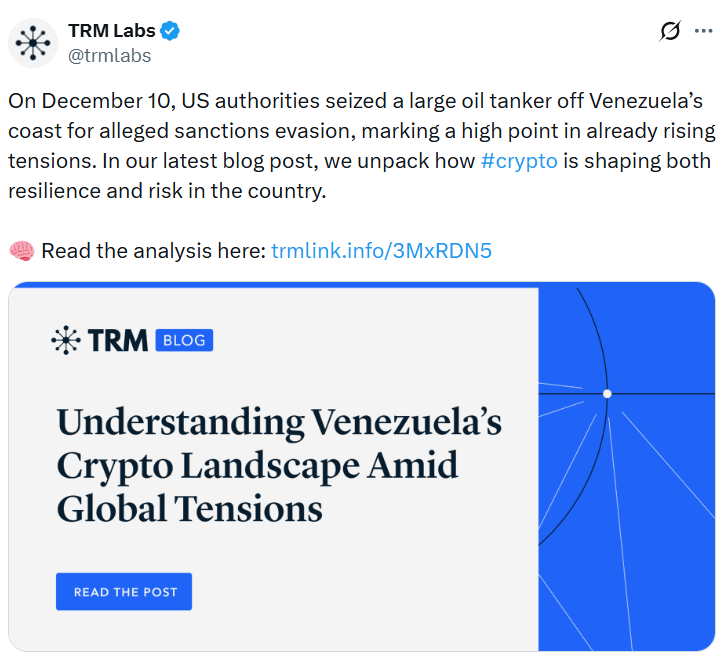
Stablecoin use in Venezuela is likely to continue growing amid persistent economic instability and international sanctions, according to a report released Thursday by blockchain intelligence firm TRM Labs.
TRM Labs said that escalating regional and geopolitical frictions, including tensions between the United States and Venezuela, have contributed to macroeconomic volatility and the continued depreciation of the bolívar. In this environment, the firm expects rising demand for stablecoins as both a store of value and a means of payment. Ongoing regulatory uncertainty surrounding the country’s crypto supervisor, SUNACRIP, coupled with diminished confidence in traditional banking services, may reinforce this trend.
TRM Labs added that, absent a significant improvement in Venezuela’s macroeconomic conditions or the establishment of clear, cohesive oversight, the role of digital assets—especially stablecoins—is likely to expand.
Venezuela ranked 18th worldwide for crypto adoption in the Chainalysis 2025 Crypto Adoption Index, and moved to 9th place when adjusted for population.
Peer-to-peer transactions remain central for Venezuelan users
Peer-to-peer transfers and USDT (USDT) conversions to local fiat have become core services for Venezuelans lacking reliable domestic banking channels, TRM Labs found.
Analyzing Venezuelan IP addresses, the firm observed that more than 38% of site visits were directed to a single global platform offering P2P trading, underscoring its role in enabling crypto access in a low-banking environment. A substantial portion of crypto-to-fiat flows occurs through platforms that support informal settlement networks, despite periodic service disruptions, the report said.
TRM Labs added that local platforms also play an important role, particularly those providing mobile wallets and integrations with domestic banks.
Crypto adoption shaped by prolonged economic strain
According to TRM Labs, Venezuela’s crypto landscape has emerged from nearly a decade of economic contraction, sanctions pressure, and government experimentation with digital financial alternatives.
Stablecoins—especially USDT—are widely used for household and business transactions. Despite compliance and sanctions-evasion concerns, TRM Labs said stablecoin activity in Venezuela is predominantly driven by necessity rather than speculation or criminal activity.
For many Venezuelans, stablecoins function as a substitute for retail banking, facilitating payroll, family remittances, vendor payments, and cross-border purchases where domestic financial services are inconsistent, the report added.
Stay informed, read the latest news right now!
Disclaimer
The content on TrustsCrypto.com is for informational purposes only and does not constitute financial or investment advice. Cryptocurrency markets are highly volatile, always do your own research before making decisions.
Some content may be assisted by AI and reviewed by our editorial team, but accuracy is not guaranteed. TrustsCrypto.com is not responsible for any losses resulting from the use of information provided.