
Today in Crypto: Post-Quantum Bitcoin, Stablecoin Tax, Sentiment
Key developments in the digital asset sector today include commentary on Bitcoin’s readiness for post-quantum security, a new U.S. legislative draft addressing taxation of stablecoin payments and staking income, and market sentiment analysis indicating that fear levels may not yet signal a definitive bottom.
Lopp: Bitcoin’s move to post-quantum security may require up to 10 years
The transition of the Bitcoin protocol to post-quantum security standards could “easily” span 5 to 10 years, according to Jameson Lopp, a Bitcoin Core developer and co-founder of crypto custody firm Casa. Lopp weighed in on a broader online debate that escalated after venture capitalist Nic Carter raised concerns about the absence of a formal quantum security roadmap for Bitcoin.
Carter urged the community to adopt post-quantum standards as soon as possible. Lopp replied: “No, quantum computers won’t break Bitcoin in the near future. We’ll keep observing their evolution. Yet, making thoughtful changes to the protocol and an unprecedented migration of funds could easily take 5 to 10 years.”
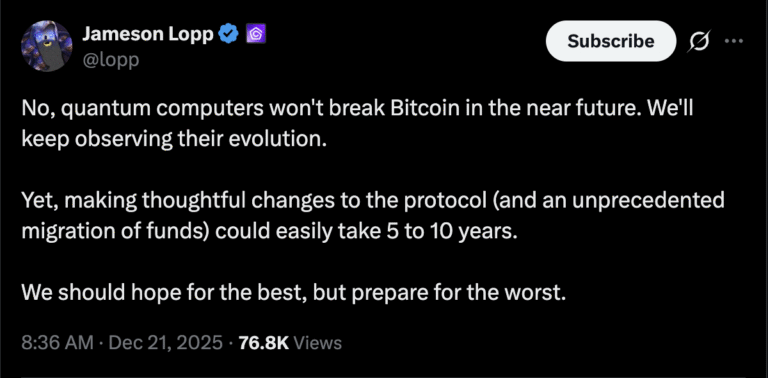
The discussion underscores a divide among stakeholders. Some Bitcoin proponents assert that any meaningful quantum threat to the network and its cryptography remains decades away, while others — including certain developers and venture capitalists — suggest quantum supremacy could arrive within five years.
U.S. draft bill would exempt small stablecoin payments and allow deferral for staking and mining rewards
U.S. Representatives Max Miller of Ohio and Steven Horsford of Nevada introduced a discussion draft aimed at reducing tax frictions for everyday crypto use by exempting small stablecoin transactions from capital gains tax and providing a deferral option for staking and mining rewards. The draft seeks to amend the Internal Revenue Code to reflect increasing digital asset use in payments and to “eliminate low-value gain recognition arising from routine consumer payment use of regulated payment stablecoins.”
Under the proposal, users would not need to recognize gains or losses on stablecoin transactions of up to $200, provided the asset is issued by a permitted issuer under the GENIUS Act, is pegged to the U.S. dollar, and maintains a tight trading range around $1. The draft includes guardrails to curb abuse: the exemption would not apply if a stablecoin trades outside a narrow price band, and brokers or dealers would be ineligible. The Treasury Department would retain authority to implement anti-abuse measures and reporting requirements.
Santiment: Social sentiment shows insufficient fear to confirm a market bottom
Crypto traders have not yet displayed sufficient fear on social media to mark a definitive market bottom, according to Maksim Balashevich, founder of market sentiment platform Santiment. In a video published on YouTube on Friday, Balashevich suggested Bitcoin could still fall toward approximately $75,000.
Such a move would imply an approximate 14.77% decline from Bitcoin’s current price of $88,350, according to CoinMarketCap. Balashevich attributed his caution to persistent optimism online that the recent downtrend will reverse in the near term — a pattern he said typically does not align with the formation of a true bottom.
Stay informed, read the latest news right now!
Disclaimer
The content on TrustsCrypto.com is for informational purposes only and does not constitute financial or investment advice. Cryptocurrency markets are highly volatile, always do your own research before making decisions.
Some content may be assisted by AI and reviewed by our editorial team, but accuracy is not guaranteed. TrustsCrypto.com is not responsible for any losses resulting from the use of information provided.