UK MPs urge rethink of BoE stablecoin rules to prevent offshoring
Members of Parliament and the House of Lords from multiple parties have asked UK Chancellor Rachel Reeves to scale back the Bank of England’s proposed framework for systemic stablecoins, warning that the plans could shift innovation and investment overseas.
In an open letter published on Thursday, signatories including former Defence Secretary Sir Gavin Williamson, shadow Science and Tech (AI) Minister Viscount Camrose, and Lord Hart, who served as chief whip under former Prime Minister Rishi Sunak, said the Bank’s approach would deter adoption and hinder the UK’s competitiveness.
Stablecoins viewed as a key component of the digital economy
The letter argues the proposals risk making the UK a “global outlier” by restricting most wholesale stablecoin activity outside the Digital Securities Sandbox, prohibiting interest on reserves, and setting what it describes as “impractical and anti-innovation” holding caps. The group said these measures could shift usage toward dollar-pegged tokens such as USDC (USDC) and USDt (USDT).
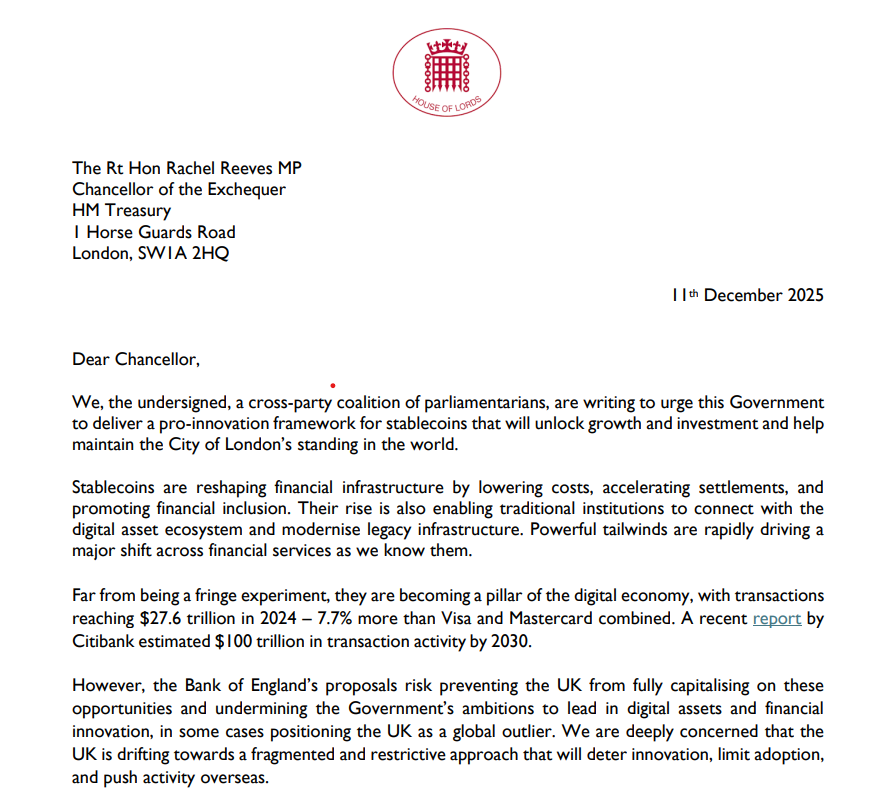
The authors said stablecoins are already becoming a foundational element of the digital economy and cautioned that the UK is moving toward a fragmented, restrictive framework that could reduce the City of London’s global standing. They noted that pound-linked stablecoins account for less than 0.1% of global issuance and argued the current approach overemphasizes depositor-flight risk while undermining the government’s ambition to make the UK a “world‑leading destination for digital assets.”
Asher Tan, co-founder and CEO of CoinJar, an FCA-registered UK exchange, said the letter reflects growing concern that the country may be applying outdated assumptions to future financial infrastructure. Jakob Kronbichler, co-founder and CEO of Clearpool, said stablecoins are already used for payments, capital markets, and onchain credit settlement, and warned that treating them as “niche or provisional” could slow adoption in areas where the UK aims to lead.
Details of the Bank of England’s proposals
Under the proposed regime for sterling-denominated systemic stablecoins, the Bank suggests temporary holding limits of 20,000 pounds ($26,500) per coin for individuals and about $13.3 million for businesses, with exemptions for the largest corporations. Issuers would be required to keep at least 40% of reserves as non-interest-bearing deposits at the Bank of England and up to 60% in short-term UK government securities.
Tan said that hard caps and constraints on reserve composition restrict functionality excessively. He added that such measures will not eliminate risk but are likely to shift activity to jurisdictions with more flexible regulations.
Comparison with other jurisdictions
In the European Union, the Markets in Crypto-Assets Regulation (MiCA) provides a live framework for euro and other asset-referenced tokens, limiting non‑EU currency stablecoins to protect monetary sovereignty rather than curbing overall market growth. By contrast, the Bank of England’s user-level caps and wholesale restrictions would more tightly constrain scale, potentially resulting in stricter usage limits than MiCA.
In the United States, the newly enacted GENIUS Act is intended to facilitate large-scale payment and settlement use without blanket per-wallet caps or a narrow sandbox approach. The letter’s authors warned that, without adjustments, the UK could cede the next phase of capital markets innovation to the EU and the US. Kronbichler said that if pound-denominated stablecoins are less efficient than offshore options, activity will likely relocate overseas.
Stay informed, read the latest news right now!
Disclaimer
The content on TrustsCrypto.com is for informational purposes only and does not constitute financial or investment advice. Cryptocurrency markets are highly volatile, always do your own research before making decisions.
Some content may be assisted by AI and reviewed by our editorial team, but accuracy is not guaranteed. TrustsCrypto.com is not responsible for any losses resulting from the use of information provided.