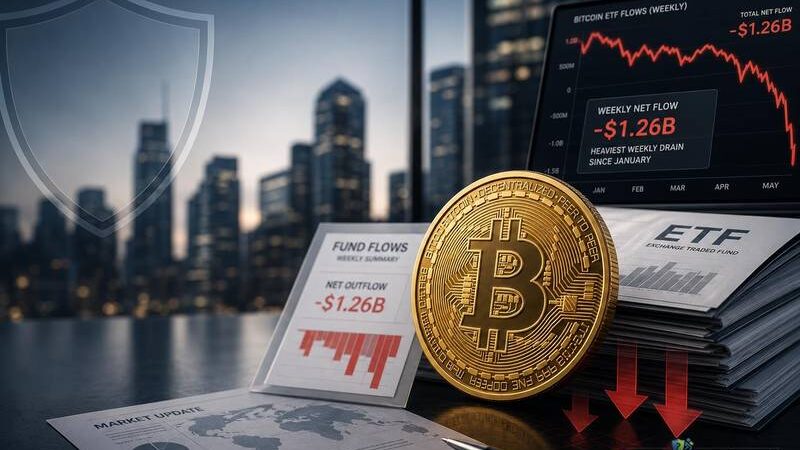
Bhutan Moves $18M in Bitcoin Amid BTC Sell-Off
Bhutan government-linked wallets moved about $18 million in Bitcoin during a fresh market slide, drawing attention because sovereign-linked transfers can shift sentiment even when the blockchain record confirms movement, not a completed sale.
A confirmed Bitcoin transaction, 61e1a19510403dae282d0492cb3e50c522afc2de46b005b15dceb11ff2264b3c, sent a main output of 249.9999 BTC on April 9, 2026 from a wallet trail that secondary reporting has tied to Bhutan-linked holdings. That exact output is the hardest verified fact in the story, and it is the key detail missing from much of the broader coverage.
Mempool.space shows the transfer was confirmed at 2026-04-09T03:43:31Z in block 944285 after spending 31,970,678,799 satoshis from the source address. The largest output landed at bc1q0ng7kkt7vt3smv82fe63tuqsq0mz5kzhptjs6x, while 6,970,688,304 satoshis returned to a different address as change and the miner fee was just 495 satoshis.
In plain terms, the explorer entry shows one outgoing payment and one remainder output. That matters because the change return explains why the transaction spent more than it delivered, while also showing that the on-chain evidence is about fund routing, not the motive behind the routing.
Bitcoin traded near $73,920 with a -0.98% 24-hour move when the transfer drew attention, which is why the output was framed as roughly the headline value during a sell-off. That pressure was already visible as Bitcoin held above $74,000 while SOL, ADA, and DOGE pulled back on Asia rebound, leaving traders primed to scrutinize any government-linked wallet movement.
What the blockchain record proves, and what it still cannot prove
The verified record shows that 24,999,990,000 satoshis reached a fresh destination wallet. It does not show a named exchange deposit address, a trade confirmation, or any other direct proof that the transfer became an open-market sale.
That distinction is the core trust issue in this story. Without a tagged exchange endpoint or a traced follow-on path from tx 61e1a19510403dae282d0492cb3e50c522afc2de46b005b15dceb11ff2264b3c, readers can verify that coins moved but cannot verify that those coins were sold into the market.
That is why phrasing matters. One CoinEdition report treated the move as another Bhutan outflow and estimated that the country still held about 3,774 BTC based on Arkham data, but that remains a single-source interpretation rather than a public confirmation from Bhutan.
No public statement from Bhutan or Druk Holding and Investments explaining the April 9 transfer was identified in the research set. Until that changes, the cleanest description is that Bhutan-linked wallets moved bitcoin during a market drop, while the purpose of the move remains unconfirmed.
Bhutan’s reserve strategy helps explain the careful framing
The wider policy context comes from the IMF’s 2026 Article IV report on Bhutan, which said the country treats Bitcoin as a strategic reserve held for the long term and uses only limited sales for operational costs. That position makes any sovereign-linked transfer notable, but it also argues against assuming every wallet movement reflects a tactical disposal.
The same IMF report warned that public-sector bitcoin estimates based on Arkham labels carry significant uncertainty because some balance drops may simply reflect transfers to unidentified wallets. That caveat is unusually important here because the article’s central evidence is a blockchain movement, while the most popular market interpretation depends on wallet attribution layers that are not fully transparent.
The IMF also described a cautious domestic framework, saying crypto on-ramping is not allowed locally and crypto activity remains inside a regulatory sandbox, even as state-linked mining and related operations expand. For investors, that means Bhutan’s bitcoin story is not just about reserve management, it is also about how a small state balances strategic exposure with tight control over local market access.
The broader crypto backdrop helps explain why traders read so much into a single transfer. Capital has been rotating unevenly across the sector, from South Korea’s move to 30% of global crypto volume as altcoins reached 85% to Tether joining a $134 million Stablecoin Development Corp funding round, even as bitcoin sentiment stays defensive.
Why sovereign-linked wallet moves still matter
A transfer of 249.9999 BTC is not automatically market-moving on its own, but sovereign-linked wallets attract outsized scrutiny because they can signal policy choices as much as liquidity needs. In a session where bitcoin was already down 0.98% over 24 hours, that signaling effect can matter more to traders than the transfer size itself.
The research brief also logged an Extreme Fear sentiment reading at the time, which helps explain the reaction even without proving causation. When market psychology is already fragile, a verified state-linked transfer becomes a narrative catalyst because the hard data is visible immediately, while official context usually arrives later if it arrives at all.
FAQ: Bhutan’s $18M Bitcoin Transfer
How much Bitcoin was moved?
The main output transferred 249.9999 BTC in the confirmed transaction, while a separate 6,970,688,304-satoshi change output returned to another wallet.
Did Bhutan sell the Bitcoin?
No public record proves a sale. The blockchain shows a wallet transfer, and the IMF said some Arkham-detected balance changes can reflect internal moves to unidentified wallets rather than confirmed disposals.
Why does the transfer matter for the market?
It happened while bitcoin was down 0.98% over 24 hours and the research brief logged Extreme Fear, so traders had a data-backed reason to watch the move closely even without proof that the coins were sold.
Disclaimer: This content is for informational purposes only and does not constitute investment advice.
Disclaimer: This article is for informational purposes only and does not constitute financial or investment advice. Cryptocurrency and digital asset markets carry significant risk. Always do your own research before making any investment decisions.